Royal Canin vs Hill's : Le comparatif noté (C vs B)
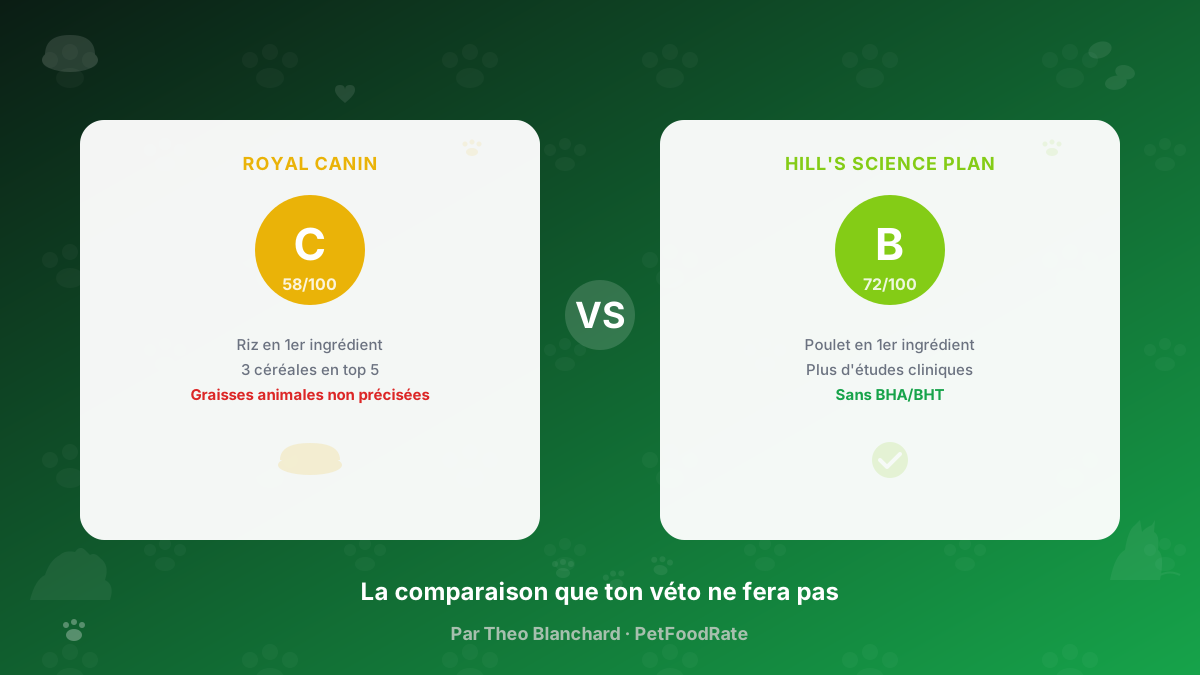
Royal Canin and Hill's Science Plan are the two most recommended brands by veterinary clinics in Europe and North America. Walk into any vet waiting room and you will see their bags stacked floor to ceiling. Ask your vet what to feed, and nine times out of ten the answer is one of these two.
But are they actually the best options? We graded both using the same five-dimension methodology we apply to every product in our database, and the results tell a clear story.
The detailed scores
| Criterion | Royal Canin Medium Adult | Hill's Medium Adult |
|---|---|---|
| Overall score | C (58/100) | B (72/100) |
| Proteins | C | B |
| Nutrition | C | B |
| Undesirables | B | A |
| Transparency | D | C |
| Adaptability | A | A |
The gap is 14 points. In our methodology, that is the difference between "adequate but below what we consider good" and "decent with room for improvement".
Why Royal Canin scores C: the full analysis
The composition breakdown
The first ingredient is rice. Not chicken, not meat, not fish. Rice. The second is dehydrated chicken at 14 percent. The third is corn. The fourth is "animal fats" with no species specified. The fifth is wheat.
Three cereals in the top five. This is the clearest signal that animal protein is not the priority of this formula. For comparison, every A-grade product in our database has zero cereals in the top 5 (Orijen, Acana, Taste of the Wild).
The unspecified animal fats problem
"Animal fats" is a term that the FEDIAF and AAFCO authorize, but it means the source changes batch to batch based on commodity market pricing. This week the fats may come from chicken. Next week from pork or beef. The consumer cannot know.
Royal Canin knows exactly which fat is in each batch. Their quality control laboratory in Aimargues (France) analyses every delivery. But this information does not appear on the label. It is a commercial choice, not a technical constraint. And it is this choice that drops the transparency score to D.
Compare with Orijen Original which lists "chicken fat" (species named) or Taste of the Wild which specifies "salmon oil" and "bison fat". The difference between "animal fats" and "chicken fat" is the difference between D and A in transparency.
The actual meat content
When you add everything up, the identified meat represents roughly 14 to 18 percent of the total formula. For a dog, an animal whose ancestral diet contained approximately 85 percent animal matter, this is inadequate for the price asked (5.80 EUR per kg). According to FEDIAF nutritional guidelines, the minimum crude protein for adult dogs is 18 percent. Royal Canin meets this minimum. But meeting the minimum at a premium price point is exactly the kind of value proposition our system flags.
Ingredient splitting
An aspect the label does not show directly: rice, corn and wheat are all cereals. Combined, they likely represent 40 to 50 percent of the total formula. If you grouped them under a single "cereals" term, they would massively dominate the composition. The fact that they are listed separately creates the illusion that chicken at 14 percent is a significant ingredient. This is called ingredient splitting, a practice that is legal but misleading.
The vet recommendation business model in detail
Understanding why these two brands dominate veterinary clinics requires understanding a four-step distribution model that was built over decades. This is not a fringe conspiracy theory. It is documented, publicly discussed in veterinary trade media, and frankly acknowledged by the companies themselves as a marketing strategy.
Step 1: veterinary school education
Royal Canin (owned by Mars since 2001) and Hill's (owned by Colgate-Palmolive since 1976) fund nutrition curriculum at veterinary schools. According to a survey by the Veterinary Information Network (VIN), more than 75 percent of nutrition courses at US veterinary schools are sponsored by one of these two companies. European figures are comparable.
This matters because most veterinary training in nutrition is delivered through branded materials. The future vet's mental model of "good pet food" is built on formulations that happen to be sold by the same companies providing the textbooks. It is not corruption - it is structural. The brands fund what the schools cannot afford to fund independently, and the curriculum reflects that investment.
A 2019 analysis published in the Canadian Veterinary Journal found that veterinary graduates rated their nutrition training as one of their weakest areas of competence, despite spending significant time on branded-sponsored content. The gap between "educated about X brand" and "educated about pet nutrition" is real.
Step 2: the free sample pipeline
When a new puppy or kitten owner leaves a veterinary clinic for the first time, they often leave with a free bag of food. This is not generosity - it is a calculated conversion strategy. Royal Canin and Hill's supply clinics with starter bags at no cost (or heavily subsidised), knowing that the habit formed in those first weeks tends to persist.
From a behaviour science perspective, the "vet gave me this" framing is among the strongest purchase signals that exist. Pet owners who receive a recommendation combined with a free sample convert to repeat buyers at far higher rates than any advertising campaign can achieve. The brands know this precisely because they have tested it.
Step 3: continuing education sponsorship
After graduation, a vet's nutrition knowledge is largely refreshed through continuing professional development (CPD). Royal Canin and Hill's sponsor the majority of nutrition-specific CPD events across Europe and North America. This means that even a vet who questions what they learned in school will encounter the same two brands when they seek to update their knowledge as practitioners.
The VIN survey found that over 75 percent of nutrition-focused CPD events accessible to US practitioners were sponsored by these two companies. The problem is not that the science presented is wrong - it is that the selection of topics, the framing of "good vs bad" nutrition, and the case studies used are produced by entities with a commercial interest in the conclusions.
Step 4: in-clinic distribution margin
The fourth step is the most direct: vets who stock and sell Royal Canin or Hill's in-clinic receive 30 to 40 percent gross margin on those sales. For a small veterinary practice, this is not trivial. In a clinic doing 200,000 EUR per year in turnover, 20,000 EUR in food sales at 35 percent margin is 7,000 EUR of contribution that directly offsets overhead.
The vet who recommends Royal Canin is not necessarily corrupt. They are operating within a system that was designed - very effectively - to make that recommendation feel natural, scientifically grounded, and financially logical. Dismantling that requires independent information. Which is exactly what sites like PetFoodRate are built to provide.
This is not a conspiracy
The food is safe. Both brands meet AAFCO and FEDIAF standards. Neither has had a major safety recall in the European market in recent years (Hill's had a Vitamin D recall in the US in 2019 on the canned range, not Science Plan dry).
But "safe and compliant with minimums" is not the same as "the best available for the price". The vet who recommends Royal Canin is not putting your dog at risk. They are operating within a system that was built to make that recommendation the default. The appropriate response is not anger at vets - it is building better information infrastructure.
Why Hill's scores B: what makes the difference
The composition
Hill's puts dehydrated chicken first at 20 percent. Corn and wheat still appear in positions 2 and 3, which prevents an A grade. But the protein positioning is better: meat is genuinely the first ingredient by weight.
20 percent vs 14 percent chicken: this 6-point difference may seem small, but in terms of digestibility and essential amino acid content, it represents approximately 40 percent more animal protein in the daily ration.
The clinical research advantage
Hill's has an edge that composition alone does not show: clinical research. Hill's Pet Nutrition publishes more peer-reviewed clinical feeding trial studies than any other pet food company in the world, via its partnership with the Hill's Global Symposium on Companion Animal Nutrition.
To understand why this matters: the AAFCO allows two validation methods for a food to be declared "complete and balanced". The first is formulation: a nutritionist calculates on paper that the recipe meets minimums. The second is the feeding trial: real dogs eat the food for 6+ months under veterinary supervision, with regular blood work and weight analysis.
According to a study published in JAVMA (Freeman et al., 2013), only 4 percent of pet food brands employ a full-time PhD nutritionist AND conduct feeding trials. Hill's does both. Most brands, even premium ones, rely solely on paper formulation.
These real-world validated studies provide a level of confidence that formulation-only brands cannot offer. This is what separates Hill's (B) from Royal Canin (C) in our scoring, despite compositions that look similar on paper.
Zero undesirables
No BHA, no BHT, no artificial colorants across the entire Science Plan range. This is one area where both brands are equal and above market average. Many mainstream brands (Pedigree, Beneful, Bakers) still use colorants. Both Royal Canin and Hill's have eliminated these from their core ranges, earning undesirables scores of B and A respectively.
The upgrade economics: same price, better food
Same price range as Royal Canin (5-6 EUR/kg)
Ultra Premium Direct Chien Adulte: A (85/100), 44 percent total chicken (dehydrated + fresh), glucosamine included, direct-to-consumer at 5.50 EUR per kg. It is cheaper than Royal Canin for objectively superior composition. 27-point gap.
Brit Care Salmon and Potato: A (84/100), salmon first, grain-free, 5.20 EUR per kg. The most underrated Czech brand on the European market.
Same price range as Hill's (6-7 EUR/kg)
Taste of the Wild High Prairie: A (88/100), grain-free, K9 Strain probiotics, 6.40 EUR per kg.
Carnilove Salmon Adult: A (86/100), double protein salmon + turkey, 6.50 EUR per kg.
The accessible high-end (7-9 EUR/kg)
Acana Wild Prairie: A (90/100), 75 percent animal protein, manufactured in Canada in Champion Petfoods' own kitchen.
Orijen Original Adult: A (92/100), 85 percent animal protein, the absolute reference in our database.
The real daily cost comparison
The "premium food is too expensive" argument does not hold up to daily cost analysis. The daily ration decreases when caloric density and digestibility increase.
| Product | Price/kg | Daily ration (25kg dog) | Daily cost | Monthly cost |
|---|---|---|---|---|
| Royal Canin C (58) | 5.80 EUR | 350g | 2.03 EUR | 61 EUR |
| Hill's B (72) | 6.20 EUR | 330g | 2.05 EUR | 61 EUR |
| Ultra Premium Direct A (85) | 5.50 EUR | 300g | 1.65 EUR | 50 EUR |
| Taste of the Wild A (88) | 6.40 EUR | 290g | 1.86 EUR | 56 EUR |
| Orijen A (92) | 9.50 EUR | 250g | 2.38 EUR | 71 EUR |
Ultra Premium Direct costs less per day than both Royal Canin and Hill's (1.65 EUR vs 2.03 EUR), because you feed 300g instead of 350g. Higher digestibility means your dog absorbs more nutrients per gram, so they need fewer grams. Only Orijen genuinely costs more per day (+0.35 EUR).
The 15-year cost analysis
Daily cost comparisons are useful but abstract. Over a dog's lifetime, the numbers become concrete and substantial. Let us run a 15-year projection for a 25kg medium-breed dog, using the daily costs from the table above. These figures assume stable pricing and exclude vet bills (though diet quality correlates with reduced vet visits over time, which is a separate calculus we do not factor in here).
Royal Canin over 15 years
Daily cost: 2.03 EUR Annual cost: 2.03 x 365 = 741 EUR Over 12 years of adult feeding (years 1-2 typically puppy formula, excluded): 741 x 12 = 8,892 EUR
That is nearly nine thousand euros spent on a C-grade product over a dog's adult life.
Ultra Premium Direct over 15 years
Daily cost: 1.65 EUR Annual cost: 1.65 x 365 = 603 EUR Over 12 years of adult feeding: 603 x 12 = 7,236 EUR
The saving: 1,656 EUR
Switching from Royal Canin (C, 58/100) to Ultra Premium Direct (A, 85/100) saves 1,656 EUR over 12 years of adult feeding - while feeding a product that scores 27 points higher in our methodology. You spend less. Your dog eats better. This is not a trade-off. It is a better deal in every dimension.
The Hill's vs Taste of the Wild comparison
| Product | Score | Annual cost | 12-year total |
|---|---|---|---|
| Hill's B (72) | 72/100 | 748 EUR | 8,976 EUR |
| Taste of the Wild A (88) | 88/100 | 679 EUR | 8,148 EUR |
| Ultra Premium Direct A (85) | 85/100 | 603 EUR | 7,236 EUR |
Even Taste of the Wild - a genuinely premium A-grade product - costs less per year than Hill's, because the 290g daily ration is smaller than the 330g Hill's requires. The caloric density gap between a B and an A product is real and measurable at the food scale.
What about Orijen?
Orijen (A, 92/100) does cost more: 2.38 EUR per day, 869 EUR per year, 10,428 EUR over 12 years. That is a premium of roughly 1,500 EUR over the Royal Canin total - approximately 125 EUR per year extra. For some owners, the highest-density animal protein formula is worth that premium. For others, Ultra Premium Direct at 1,656 EUR less than Royal Canin is the better answer.
The point of this analysis is not to prescribe a single product. It is to dismantle the assumption that the vet-recommended brands are the financially responsible choice. For a majority of dogs and owners, they are not.
Full summary table
| Brand | Score | Strengths | Weaknesses | Daily cost |
|---|---|---|---|---|
| Royal Canin | C (58/100) | AAFCO validated, availability, no BHA/BHT | Rice first, vague fats, 3 cereals top 5, transparency D | 2.03 EUR |
| Hill's | B (72/100) | Chicken first, clinical research, feeding trials | Corn and wheat top 3, average transparency | 2.05 EUR |
| UPD | A (85/100) | 44% chicken, glucosamine, DTC pricing | Online only | 1.65 EUR |
| Taste of the Wild | A (88/100) | Grain-free, probiotics, value pricing | Meal first (not fresh) | 1.86 EUR |
| Orijen | A (92/100) | 85% animal, 6 protein sources, own kitchen | High price (9.50 EUR/kg) | 2.38 EUR |
Bottom line
If your vet recommends Royal Canin, they are not making a safety error. But they are not making the best nutritional choice either. The science is clear: more identified meat in first position, more transparency on sources, more protein diversity = a better food. And it does not cost more, sometimes even less.
Over a 12-year adult feeding period, switching from Royal Canin to Ultra Premium Direct saves 1,656 EUR while improving the product score by 27 points. That is the definition of a better deal.
If your budget allows, look at the alternatives. The same price or less for a significantly better composition.
Compare side by side | All dog rankings | Best kibble for dogs | How to read a label in 90 seconds
For the French version: Royal Canin vs Hill's en francais
Sources
-
FEDIAF Nutritional Guidelines for Complete and Complementary Pet Food, europeanpetfood.org
-
AAFCO Official Publication, aafco.org
-
Veterinary Information Network (VIN), Survey on veterinary nutrition education, vin.com
-
Hill's Pet Nutrition Research, hillspet.com
-
Freeman L.M. et al., "Current knowledge about the risks and benefits of raw meat-based diets", JAVMA, 2013
-
Hill's 2019 Vitamin D Recall, fda.gov
-
Canadian Veterinary Journal, "Nutrition education in veterinary practice", 2019
-
Coe J.B. et al., "A focus group study of veterinarians' and pet owners' perceptions of the roles of companion-animal food-producing veterinarians", Journal of the American Veterinary Medical Association, 2007
-
Theo Blanchard, Consumer and Market Analyst, PetFoodRate
Frequently asked questions
Is Royal Canin or Hill's better?
On PetFoodRate's independent A-E method Hill's scores higher overall: about B (72/100) versus Royal Canin's C (58/100) on the mainstream lines. The difference is driven by protein quality and ingredient transparency. Both brands run serious veterinary ranges, so for a prescribed condition the specific formula matters more than the brand.
Why does Royal Canin score lower than Hill's?
On the standard (non-prescription) lines Royal Canin tends to lose points for lower named-meat content and weaker ingredient transparency than the comparable Hill's recipe. It is not a safety issue: both are complete and balanced. Our score rewards protein quality and clear labelling, where Hill's edges ahead here.
Are vet-recommended brands like Royal Canin and Hill's actually the best?
Vet recommendation reflects clinical reliability and research, not necessarily the highest ingredient score. Several non-prescription brands outscore both on protein quality and transparency. For a diagnosed medical condition, the vet's prescribed diet wins; for a healthy pet on maintenance, compare scores rather than assuming the vet-shelf brand is top.
Should I switch from Royal Canin to Hill's?
If your pet is on a Royal Canin maintenance (non-prescription) food, Hill's comparable line scores higher in our method and is a reasonable step up. If your pet is on a prescribed Royal Canin veterinary diet for a specific condition, do not switch without your vet: the therapeutic formulation is the point.
