Décrypter étiquette croquettes : 7 pièges en 90 secondes
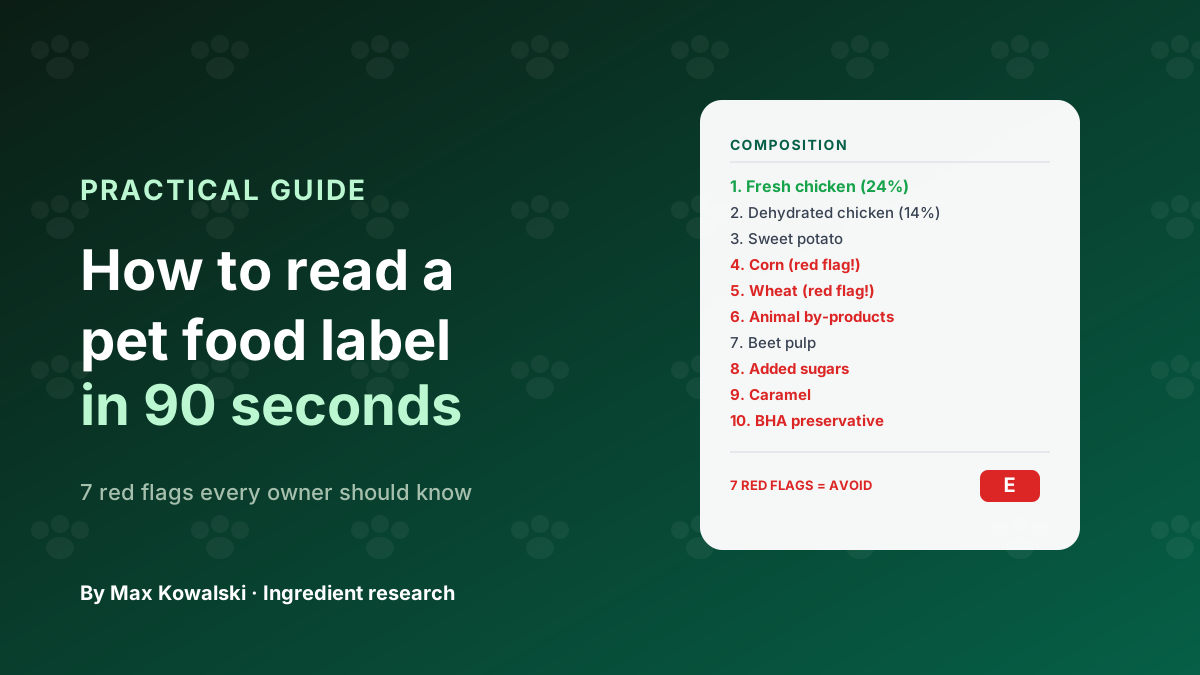
The back of a pet food bag holds more useful information than the entire front. The front is marketing: prairie photos, wolf imagery, "real meat" claims. The back is regulation. And once you know what to look for, you can grade any product in 90 seconds without a database, without an app, without asking your vet.
Here is the workflow we use at PetFoodRate to score over 1300 products, simplified into seven red flags. Each flag corresponds to a real criterion in our methodology. If a product hits one, it drops a grade. If it hits three or more, put it back on the shelf.
For a worked example of checking a current formula against an older listing, read our Brit Care Adult salmon review. It distinguishes the manufacturer declaration, the product score and the information you still need before ordering.
How pet food labeling works
Before diving into the red flags, you need to understand the rules of the game. In Europe, pet food labeling is governed by EU Regulation 767/2009 and the FEDIAF (European Pet Food Industry Federation) guidelines. In the US, it is the AAFCO (Association of American Feed Control Officials) rules, enforced by the FDA.
Both systems share the same core principles:
- Ingredients are listed by weight before processing (before cooking, before dehydration). The first ingredient is the heaviest in the raw recipe.
- Percentages are only mandatory for ingredients highlighted on the packaging (the "25 percent rule" in the US, the "4 percent rule" in Europe for flavour-descriptive terms like "with chicken").
- The guaranteed analysis (crude protein, fat, fibre, moisture) is mandatory. It tells you the macronutrients but not the quality of the sources.
- Nutritional additives (taurine, vitamins, minerals, glucosamine) are listed separately after the composition.
This framework creates a massive information asymmetry. A manufacturer can legally write "with beef" on a bag containing 4 percent beef and 35 percent corn. That is exactly what regulations allow. And that is exactly why you need to read the fine print.
Red flag 1: a grain or vegetable in first position
The composition list is ordered by weight before cooking. The first ingredient is the heaviest. For dogs and cats (omnivores leaning carnivore and obligate carnivores respectively), the first ingredient should always be a named animal protein.
Royal Canin Medium Adult scores C (65/100) for the recipe checked on 8 September 2026. Dehydrated poultry proteins come first; crude protein is 25%. Check current pack prices and feeding quantities before comparing costs.
Compare with Orijen Original Adult: fresh chicken first at 38 percent, followed by fresh turkey. Score: A (92/100).
The difference between a C and an A often starts here, on the first line.
Exception: for rabbits, guinea pigs, and chinchillas (strict herbivores), the first ingredient should be timothy hay or alfalfa, not meat.
Red flag 2: vague animal terms
"Meat and animal by-products", "animal derivatives", "animal fats", "transformed animal proteins", "poultry meal" without a species name. These are legal terms authorized by the FEDIAF and AAFCO that tell you nothing about what species the protein came from.
The reason brands use vague terms is commodity sourcing: they buy ingredients on spot markets where the species varies week to week based on price. This week's "animal fats" might be chicken fat, next week's might be pork rendered from slaughterhouse waste. The recipe looks identical on paper. The actual nutrient profile is not.
In our methodology, this directly impacts the transparency sub-score. A product with unspecified "animal fats" cannot score above D in transparency, regardless of everything else.
What to look for instead: "chicken fat", "salmon oil", "lamb meal", "duck dehydrated". The species name is the guarantee.
Red flag 3: BHA, BHT, ethoxyquin, propylene glycol
These are synthetic preservatives. BHA (butylated hydroxyanisole) and BHT (butylated hydroxytoluene) are classified as "possibly carcinogenic to humans" by the International Agency for Research on Cancer (IARC). Long-term rodent studies showed hepatic and gastric tumours at high doses (Ito et al., 1986, Journal of the National Cancer Institute).
Ethoxyquin was originally developed as a rubber stabiliser. It is banned from human food in Europe since the 1990s but persists in some imported pet food because animal food regulations are more permissive.
Natural alternatives work well and are used by every A-grade brand in our database: vitamin E (mixed tocopherols), rosemary extract, and vitamin C (ascorbic acid). If you see BHA or BHT on the label, there is no technical reason for it other than cost savings.
Red flag 4: added sugars
Look for "sugar", "sucrose", "glucose syrup", "molasses", "caramel", "corn syrup" in the composition. None of these belong in pet food. Dogs have only about 1,700 taste buds (vs. 9,000 in humans) and cats have only 470, with virtually no sweet receptors.
Sugar is added for two reasons: caramelisation (colour) and palatability enhancement (making cats eat faster, which drives repeat purchases). The long-term cost is dental disease, weight gain, and in cats, increased risk of type 2 diabetes. A study published in the Journal of Veterinary Internal Medicine (Prahl et al., 2007) found that 59 percent of cats over 6 years showed signs of periodontal disease, a condition exacerbated by simple carbohydrates in the diet.
This red flag is most common on cheap wet pouches (Whiskas, Friskies, Felix, Sheba, Cesar) where sugar masks the meat-poor recipe. Premium wet food (Applaws, Lily's Kitchen, Schesir) never adds sugar.
Red flag 5: artificial colours
"Colorants", numbered colourings (E102, E110, E129), "caramel colour" added for cosmetic purposes. Pets do not see food colour the way humans do. Dogs see in dichromacy (blue-yellow), cats have even more limited colour vision. Bright red kibble or bright orange chunks are aimed at the human shopper, not the eater.
According to the European Food Safety Authority (EFSA), several of these colorants require warning labels on human food ("may have an adverse effect on activity and attention in children"). This requirement does not apply to pet food products, which is a regulatory gap that benefits manufacturers.
Beneful, Bakers, and Pedigree wet sometimes use colorants to make corn-based recipes look meatier. If a brand needs to dye the food to look like meat, the food is not meat. In our scoring, any artificial colorant automatically drops the undesirables sub-score.
Red flag 6: the first percentage is below 20
If the first identified meat is "chicken (4 percent)", the bag is mostly something else. This is the "4 percent rule" in Europe: when a manufacturer writes "with chicken" or "chicken flavour", they only need to include 4 percent.
Concrete examples:
- A supermarket wet pouch "with beef" contains 4 percent beef and 96 percent water, by-products, cereals, and sugar.
- Taste of the Wild High Prairie lists 32 percent total animal protein (bison, venison, lamb), with no single ingredient below 10 percent in the top positions. Score: A (88/100).
The rule of thumb: the first animal percentage should be at least 20 percent, ideally above 25.
According to AAFCO labeling rules, the naming convention itself reveals the content: "Beef Dog Food" requires 95 percent beef. "Beef Dinner" requires 25 percent. "With Beef" requires only 3 percent. "Beef Flavour" requires zero percent real beef. The word on the front of the bag tells you more than you think, if you know the code.
Red flag 7: three or more cereals in the top five
"Corn, wheat, sorghum, rice" appearing across positions 2 to 5 means cereals dominate the recipe even if the first ingredient looks acceptable.
This is also often a sign of ingredient splitting: a bag may contain 35 percent total corn but list it as "ground corn", "corn gluten", "corn flour" so each fraction ranks individually below the meat at 18 percent. The bag legally says "chicken first" but actually contains twice as much corn.
In our methodology, the number of cereals in the top five directly impacts both the proteins and nutrition sub-scores. A product with 3 or more cereals in the top 5 cannot exceed C in proteins.
| Cereals in top 5 | Max protein score | Examples |
|---|---|---|
| 0 | A | Orijen, Acana, Carnilove |
| 1 | B | Hill's Science Plan |
| 2 | C | Pro Plan Adult |
| 3+ | D or E | Pedigree Adult |
The 90-second checklist
When you pick up a bag in the supermarket or browse an online shop, apply this grid:
- Ingredient 1: named animal protein? If it is a cereal or legume, put it back.
- Vague terms: "meat by-products", "animal fats" without species? Red flag.
- Preservatives: BHA, BHT, ethoxyquin? Put it back.
- Sugars: sugar, glucose, molasses, caramel? Red flag.
- Colorants: E102, E110, E129, "caramel colour"? Red flag.
- First percentage: above 20 percent? Pass. Below? Red flag.
- Cereals in top 5: three or more? It is a cereal bag with meat flavouring.
If a bag passes all seven, it is at least a B in our system. If it fails three or more, it is likely a D or E. Our full methodology adds two more layers (transparency depth and species adaptability) for the precise letter grade, but this seven-flag check captures most of the signal.
Three products that pass all seven
| Product | Score | Ingredient 1 | Cereals top 5 | Preservatives |
|---|---|---|---|---|
| Orijen Original Adult | A (92/100) | Fresh chicken 38% | 0 | Natural tocopherols |
| Taste of the Wild High Prairie | A (88/100) | Bison meal 28% | 0 | Tocopherols + rosemary |
| Ultra Premium Direct Adult | A (85/100) | Dehydrated chicken 26% | 0 | Vitamin E |
Three products that fail the flags
| Product | Score | Red flags triggered |
|---|---|---|
| Pedigree Adult | E (38/100) | Cereal first, vague terms, colorants, 3 cereals top 5 |
| Friskies Adult | E (35/100) | Cereal first, vague by-products, colorants, sugars |
| Royal Canin Medium Adult | C (65/100) | Ingredient percentages and moisture not disclosed for the French formula |
The Mars-Nestle market reality
Here is the context that the label system cannot show you: the pet food industry is a near-duopoly, and understanding this explains why independent label reading matters more than almost any other consumer skill you can develop.
Mars Petcare and Nestle Purina together control over 70 percent of the global dry pet food market by value. Mars Petcare alone owns Royal Canin, Pedigree, Whiskas, Sheba, Cesar, IAMS, Eukanuba, Nutro, and dozens of regional brands. Nestle Purina owns Purina Pro Plan, Purina ONE, Felix, Friskies, Beneful, and Fancy Feast.
This concentration has several consequences that directly affect what ends up on your shelf:
Distribution leverage. When Mars or Nestle negotiate shelf space with supermarkets, they negotiate as portfolio owners, not single-brand vendors. A supermarket that wants Whiskas and Felix and Pedigree - which together occupy three to four full shelf bays - must negotiate with the same entity. Independent brands have no comparable leverage. This is why you see four bays of Mars and Nestle brands and a single half-bay of independents in most European supermarkets.
Veterinary investment. The four-step model described in our Royal Canin vs Hill's comparison - education, samples, CPD, in-clinic margin - is only affordable at scale. Only companies with Mars or Nestle-level revenues can sustain multi-decade investment in veterinary school curriculum. Smaller independent brands with better compositions simply cannot compete for vet mindshare.
Research funding. Peer-reviewed studies on pet food nutrition are largely funded by these same companies. When Hill's publishes a feeding trial, it is genuine science - but it is also science that validates Hill's products. Independent funding for comparative nutrition research across brands is almost non-existent. The FEDIAF itself is a trade body whose membership is dominated by the large players.
What this means for you: when you walk into a supermarket or a veterinary clinic, the brands with the most visible presence are not there because they are the best. They are there because they have the marketing budgets to buy that presence. The product that scored A in our database of 1,300 products may not be on any shelf in your local shop - because it is made by a company with 200 employees and no promotional budget.
This is not a reason for despair. It is a reason to use tools like PetFoodRate's rankings and this seven-flag checklist. The information advantage that the duopoly spends billions to maintain is erased the moment you know what to read on the back of the bag.
The upgrade economics
A cost comparison needs current pack prices and feeding quantities appropriate for your animal. Scores alone cannot establish savings.
Compare current pack costs
Comparative costs for Royal Canin Medium Adult and Brit Care Dog Grain-free Adult are not established here. Check current pack prices, delivery charges and appropriate feeding quantities before calculating daily or annual differences.
Beyond the composition: what the label does not tell you
The label gives you composition and guaranteed analysis. It does not tell you:
- Digestibility: two bags with 30 percent crude protein can have digestibilities of 75 percent and 92 percent depending on source quality. Dehydrated chicken (85-90 percent digestibility) is not the same as "poultry by-product meal" (60-75 percent).
- Geographic origin: you do not know if the chicken comes from France, Brazil, or Thailand.
- Feeding trials: AAFCO allows two validation methods. Formulation (paper calculation) or feeding trial (testing on animals for 6+ months). Only the second proves the product actually nourishes a real animal. Hill's is known for conducting more feeding trials than any other brand.
This is exactly why our score includes a transparency criterion: brands that disclose more than the legal minimum are rewarded.
You can compare any two products side by side on PetFoodRate, or browse the full dog rankings and cat rankings.
For the French version of this guide: Lire une etiquette pet food en 90 secondes
All rankings | Our methodology | Ingredient glossary
Frequently asked questions
How can I quickly evaluate a pet food label for quality?
You can quickly evaluate a pet food label by focusing on the back of the bag and looking for seven specific "red flags" as outlined by experts. Each identified red flag indicates a drop in product quality, and if three or more are present, it is advisable to choose a different product. This method allows for a rapid assessment, often within 90 seconds, without needing external databases or expert consultation.
What are the main differences in pet food labeling regulations between Europe and the United States?
Pet food labeling in Europe is primarily governed by EU Regulation 767/2009 and FEDIAF guidelines, while in the United States, it follows AAFCO rules enforced by the FDA. Despite these distinct regulatory bodies, both systems share core principles, such as requiring ingredients to be listed by weight before processing. Understanding these frameworks helps consumers interpret labels accurately based on their geographical location.
Why is the order of ingredients on a pet food label significant?
The order of ingredients on a pet food label is significant because regulations in both Europe and the US require them to be listed by weight before processing. This means the ingredient appearing first contributes the most weight to the product, and subsequent ingredients are listed in descending order of their pre-processing weight. Consumers should be aware that ingredients like "fresh chicken" contain a high percentage of water, which inflates their initial weight, potentially misleading about the actual dry matter content.
What should I ignore on the front of a pet food bag when assessing its quality?
You should ignore marketing claims and imagery typically found on the front of a pet food bag, such as "prairie photos," "wolf imagery," or vague "real meat" claims. These elements are designed for consumer appeal rather than providing factual information about the product's nutritional content or quality. The crucial, regulated information necessary for a proper evaluation is consistently located on the back of the packaging.
Sources
-
FEDIAF Nutritional Guidelines for Complete and Complementary Pet Food, europeanpetfood.org
-
EU Regulation 767/2009 on the placing on the market and use of feed, eur-lex.europa.eu
-
AAFCO Official Publication, Pet Food Labeling Guide, aafco.org
-
FDA, Pet Food Labels - General, fda.gov
-
IARC Monographs on the Identification of Carcinogenic Hazards to Humans, BHA evaluation, monographs.iarc.who.int
-
Prahl et al., "Prevalence of periodontal disease in cats", Journal of Veterinary Internal Medicine, 2007
-
EFSA, Re-evaluation of food colour additives, efsa.europa.eu
-
Euromonitor International, Pet Care Global Industry Overview 2024
-
Mars Petcare brand portfolio and market share data, mars.com
-
Coe J.B. et al., "A focus group study of veterinarians' and pet owners' perceptions", Journal of the American Veterinary Medical Association, 2007
-
Max Kowalski, Ingredient Research, PetFoodRate
Product references checked on 8 September 2026: Royal Canin Medium Adult ; Brit Care Dog Grain-free Adult. Scores concern these specific recipes, not brand averages. “n.d.” indicates data not verified for the current reference.
